VR-EF Kinematic ML Pipeline
Neurodevelopmental disorders such as attention-deficit/hyperactivity disorder (ADHD) affect millions of children and are characterized by executive function (EF) deficits, including planning and impulse control. While conventional EF assessments might lack ecological validity and overlook subtle behavioral differences, virtual reality (VR) provides immersive environments and precise kinematic data, enabling objective, quantitative measures and remote administration for early detection.
However, these VR-based measures generate voluminous datasets that require substantial processing to extract meaningful features and track performance. We aim to prototype a machine learning pipeline for classifying children with ADHD from their typically developing (TD) peers using kinematic data from VR-based EF tasks.
Ongoing @ The Hospital for Sick Children (SickKids)
This research project is a work-in-progress.
Research Methodology
Using the National Research Council Canada's bWell platform, pediatric participants aged 6–12 (ADHD and TD controls) completed four five-minute VR tasks assessing response inhibition, delay aversion, visual working memory, and multitasking/planning. Absolute head and hand position and rotation data were collected and processed through a comprehensive pipeline involving participant/task segmentation, signal filtering, uniform resampling, and time-windowing. From this kinematic data, features were extracted across four distinct categories:
Time-Domain Kinematic
Movement velocity and acceleration
Spatial
Spatial movement and efficiency
Behavioural
Movement timing and behavior
Frequency-Domain
Frequency analysis and complexity
Preliminary Results - Feature Extraction
The figure below provides an illustrative example of mean head movement speed during the “Mole” response inhibition task for two representative participants—one with ADHD (red) and one TD (blue). This example demonstrates the type of kinematic patterns we observe, though no inferential conclusions should be drawn from this single case comparison. The visualization shows how VR-based kinematic data can capture distinct movement characteristics that may relate to EF differences.
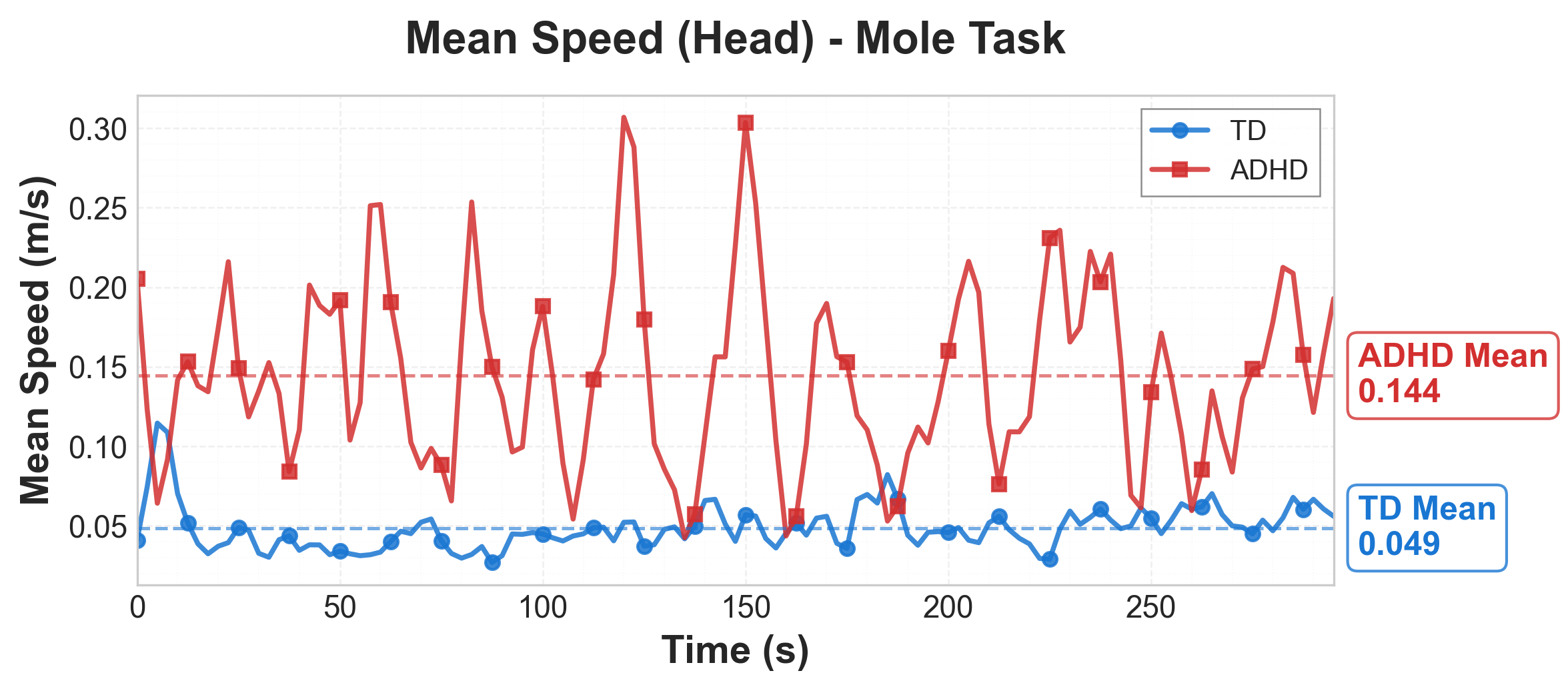
Mean head speed for individual ADHD and TD participants during the Mole (response inhibition) task, computed over 5 s windows with 50% overlap (illustrative example)
Clinical Significance
The intention behind this approach is to support the development of remote, objective tools for assessing EF in neurodevelopmental disorders, providing rich, ecologically valid insights.
This work represents a step toward leveraging VR to improve accessibility and sensitivity in neurodevelopmental disorder screening and management, potentially enabling more accurate diagnoses and personalized treatment approaches.
Authors
Demeng Chen
University of Toronto & The Hospital for Sick Children
Theodore C.K. Cheung, PhD
The Hospital for Sick Children
Vincent Gagnon Shaigetz, MSc
National Research Council Canada
Alex Chan, MSc
The Hospital for Sick Children
John E. Muñoz, PhD (Co-Senior Author)
Wilfrid Laurier University
Jennifer Crosbie, PhD (Co-Senior Author)
The Hospital for Sick Children & University of Toronto
Funding Acknowledgement
Demeng Chen was supported by the CHILD-BRIGHT Summer Studentship and the Lunenfeld Summer Studentship.